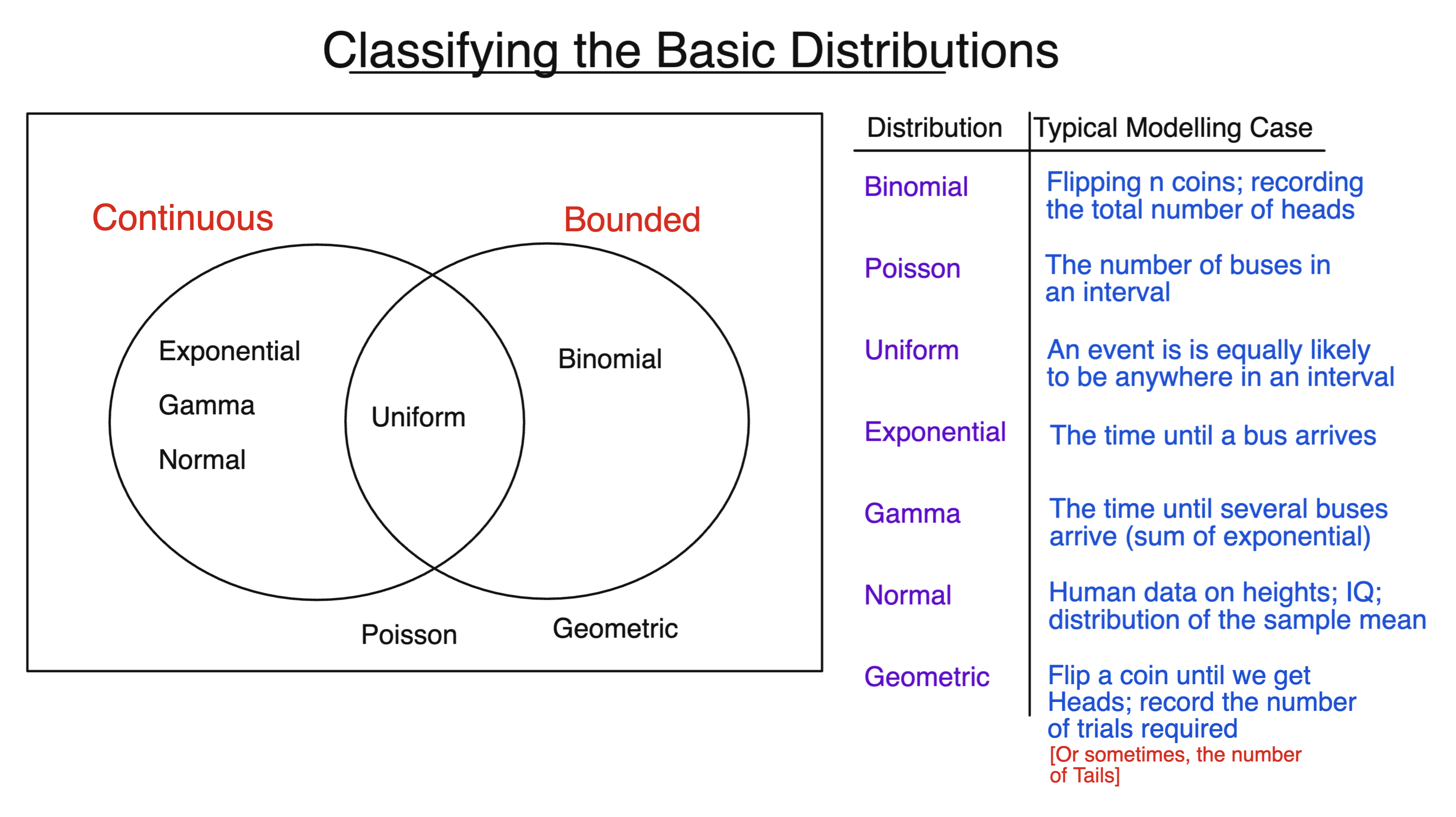
How Can we Identify Which distribution We Have?
The best way to identify a common distribution is to memorise a typical “prototype” example of when it arises.
For instance, a binomial distribution must be something similar to flipping a coin a fixed number of times, and counting the number of “heads”. It need not be exactly this; it could also, for instance, be firing an arrow at a target and counting how many times we hit it. But it’s useful to keep the coins in mind as our prototype.
Another way to identify distributions is to think about the properties shown in the Venn diagram above.
To recognise a distribution, we ask:
– It is bounded or unbounded?
- It is continuous or discrete?
A continuous distribution is one which takes values in an interval (or series of intervals), and we find probabilities by looking at the area under its PDF in that range. For a discrete distribution, in contrast, we use the PMF to find probabilities that it takes particular values. Some complex distributions are neither discrete nor continuous.
A bounded distribution has fixed limits for how big and how small it can be.