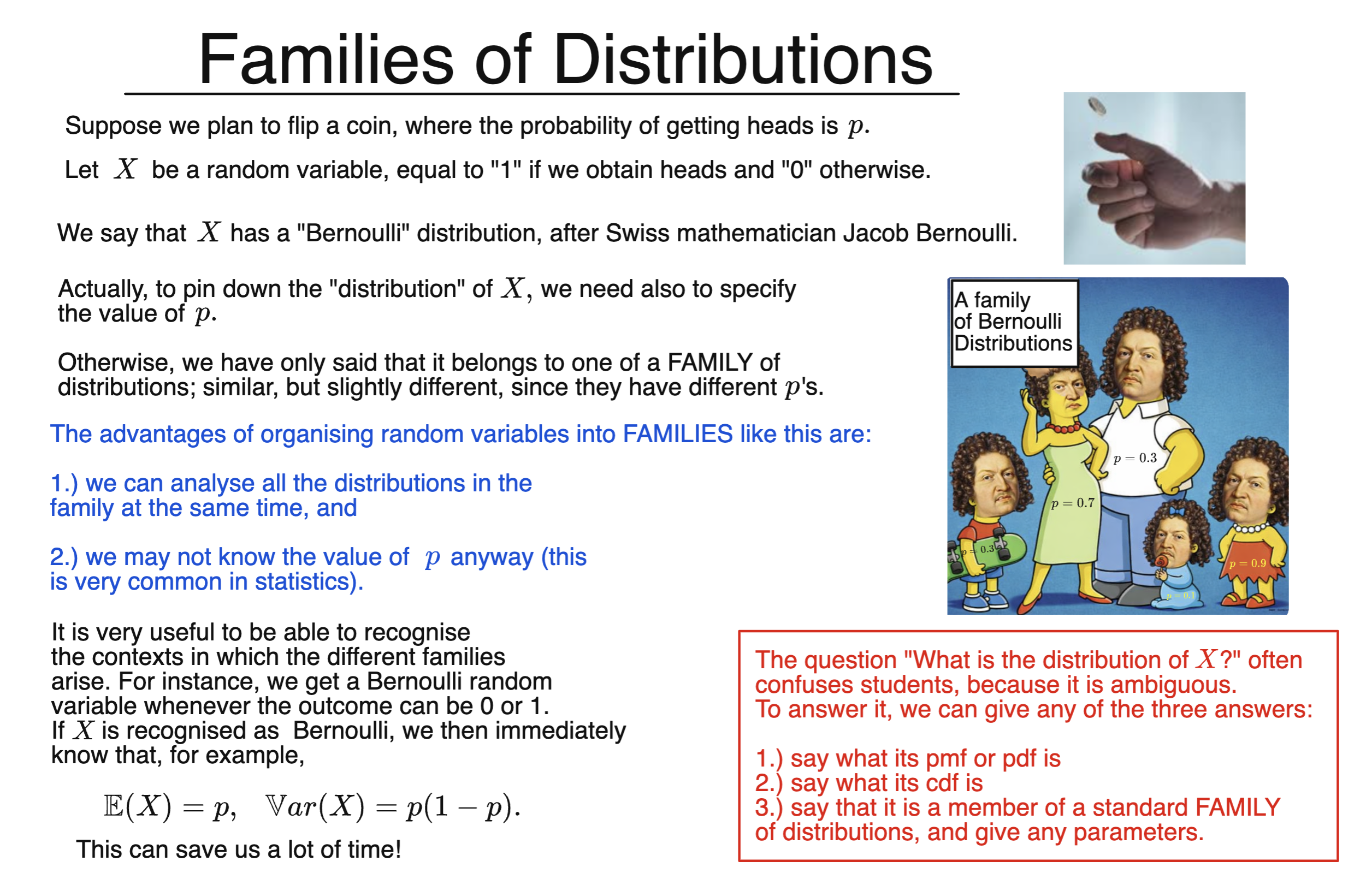
What are families of distributions?
We organise random variables into standard families of distributions, where distributions in the same family behave similarly. Mathematically, this means that their PMFs (or PDFs) have the same basic form, but are not exactly the same, because they have different “parameters”.
To pin down a member of a particular family we must say what these parameters are. For instance, the Bernoulli distribution family can represent the outcome of a coin toss, with the parameter $p$ being the probability of heads. It can also be used any time there are exactly two outcomes of interest.
If $X$ is Bernoulli with parameter $p$, we write:
$$X \sim \text{Bernoulli}(p) $$
In general, then, a family of distributions (or parametric family) is a collection of distributions, labelled (or “indexed”) by one or more parameters.
Recognising that we have a member of one of these standard families of distributions is very useful, because we can then easily access information about them, such as their expectation or variance.
To answer the question of what distribution $X$ has, we can:
– give its PMF (or PDF)
– give its CDF
– identify it as a member of a standard family, and give any parameters