What is a Binomial Random Variable?
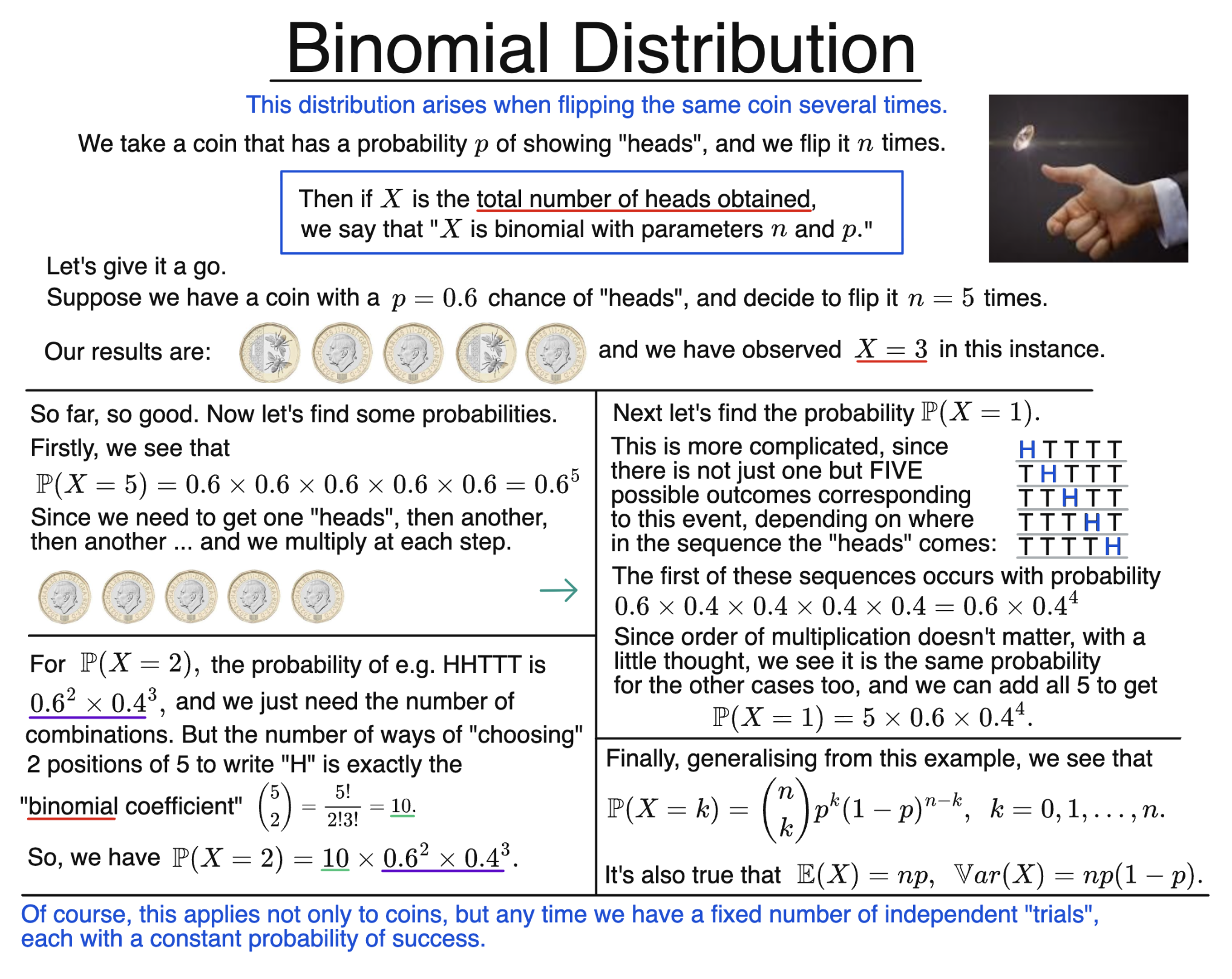
The binomial distribution arises when we repeat the same “trial” a fixed number of times. Each trial has exactly two outcomes, and the trials are independent (don’t affect each other) – like flipping a coin. The probability of success, $p$, must always be the same in each trial.
One of the two outcomes is thought of as a “success”, such as getting “heads”. We are interested in counts how many times this favoured outcome comes up.
The random variable $X$ has a binomial distribution if it is equal to the number of successes in $n$ independent trials, each with the same probability $p$ of success.
We write this as:
$$ X \sim \text{Bin}(n,p)$$
| Notation: | $X \sim \text{Bin}(n, p)$ |
| Type: | $ \text{Discrete} $ |
| PMF: | $\mathbb{P}(X = k) = \binom{n}{k} p^k (1-p)^{n-k}$ |
| Support: | $k \in \{0,1,2,\dots,n\}$ |
| Mean: | $\mathbb{E}(X) = np$ |
| Variance: | $\mathbb{V}\text{ar}(X) = np(1-p)$ |