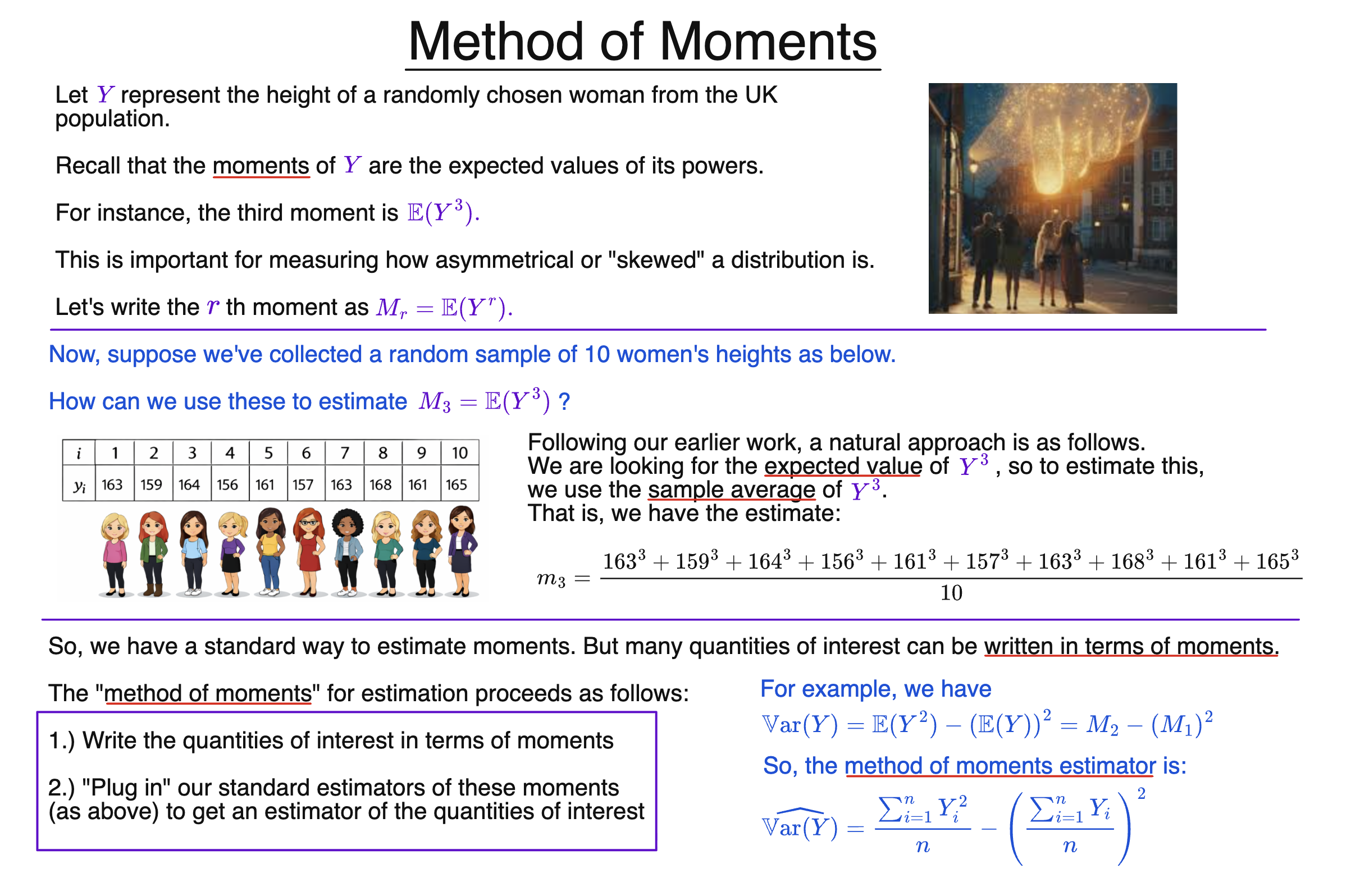
What is the Method of Moments?
The method of moments works by first writing quantities of interest in terms of the moments of a distribution, and then replacing these moments with their standard estimators to give estimators of these quantities of interest.
Recall that if $Y$ is a random variable, its moments are the expected values of its powers:
$$\mathbb{E}(Y), \ \ \mathbb{E}(Y^2), \ \ \mathbb{E}(Y^3), \ \ \dots$$
Let’s write the $r^{th}$ moment $\mathbb{E}(Y^r)$ as $M_r$.
Now, suppose we have some data drawn from this distribution:
$$y_1, y_2, \dots , y_n$$
It is natural to estimate $M_r$ by looking at the sample average of $Y^r$.
Let’s write $m_r$ for this estimate of $M_r$:
$$m_r = \frac{y_1^r+y_2^r+y_3^r+\dots + y_n^r}{n} = \frac{1}{n} \sum_{i=1}^n y_i^r $$
That is, we look at the average of the $r^{th}$ power of each data point.
Now, other quantities of interest can often be written in terms of the moments.
For instance, consider the skewness of a random variable:
$$ \gamma_1(Y) = \mathbb{E} \left( \left( \frac{Y-\mu}{\sigma} \right)^3 \right)$$
This can be written in terms of the moments as follows:
$$ \gamma_1(Y) = \frac { \mathbb{E} \left( \left(Y-\mu \right)^3 \right)}{\sigma^3} = \frac { \mathbb{E} (Y^3)-3\mu \ \mathbb{E}(Y^2)+3 \mu^2 \ \mathbb{E}(Y)-\mu^3}{(\mathbb{V}\text{ar}(Y))^{3/2}} = \frac { M_3-3M_1M_2+2M_1^3}{(M_2-M_1^2)^{3/2}} $$
Replacing true moments with their sample estimators, on the numerator we get:
$$ \left(\frac{1}{n}\sum_{i=1}^n Y_i^3 \right)-3 \left(\frac{1}{n} \sum_{i=1}^n Y_i \right) \left(\frac{1}{n} \sum_{i=1}^n Y_i^2 \right) +2 \left( \frac{1}{n} \sum_{i=1}^n Y_i \right)^3$$
and on the denominator:
$$\left( \left( \frac{1}{n} \sum_{i=1}^n Y_i^2 \right) - \left( \frac{1}{n} \sum_{i=1}^n Y_i \right) ^2 \right)^{3/2}$$
Taking the ratio of these random variables, we obtain the method of moments estimator for the unknown population value $\gamma_1(Y)$.