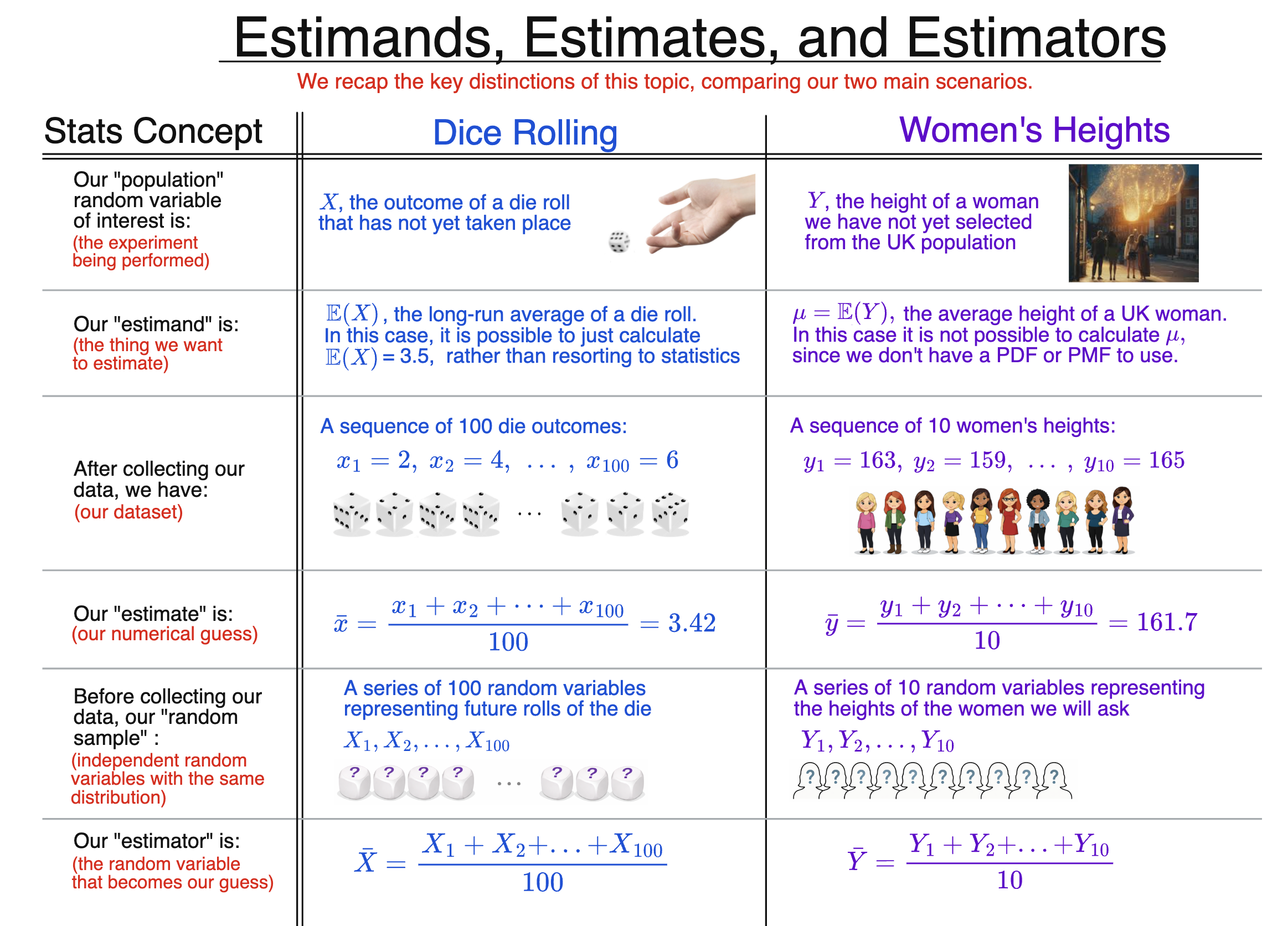
Recap of Key Concepts
The distinction between an estimand, an estimate, and an estimator is fundamental to statistics, so we present a short recap here.
Estimand
This is an unknown number we try to estimate, like $\mathbb{E}(Y)$ or $\mathbb{V}\text{ar}(Y)$, for a random variable $Y$.
Usually, we do not know the PDF or PMF of $Y$ – often because it represents a real-world outcome, rather than something artificial like rolling a perfect die. In such cases, these estimands cannot be calculated using probability theory, and we must resort to statistical methods.
Estimate
This is a numerical value computed from a particular sample $y_1, y_2, \dots , y_n$, which we think of as an informed guess of the thing we are trying to find (the estimand).
For instance, the observed sample mean:
$$\bar{y}=\frac{y_1+y_2+\dots +y_n}{n}$$
Or the observed sample variance:
$$ s_n^2 = \frac{(y_1-\bar{y})^2+(y_2-\bar{y})^2+\dots +(y_n-\bar{y})^2}{n-1} $$
Note that given particular values of $y_1, y_2, \dots , y_n$, we can actually evaluate both of these as numbers.
If we draw another sample, our estimates will usually change.
Estimator
This is like an estimate, but considered prior to collecting our data, when our observations are still random variables.
That is, it is a function of the random sample $Y_1 ,Y_2, \dots , Y_n$.
For instance, the sample mean:
$$\bar{Y}=\frac{Y_1+Y_2+\dots +Y_n}{n}$$
Or the sample variance:
$$ S_n^2 = \frac{(Y_1-\bar{Y})^2+(Y_2-\bar{Y})^2+\dots +(Y_n-\bar{Y})^2}{n-1} $$
Note that both $\bar{Y}$ and $S_n^2$ are random variables in their own right – and as such, it makes sense to calculate their expected values and variances.