How Do We Transform Random Variables?
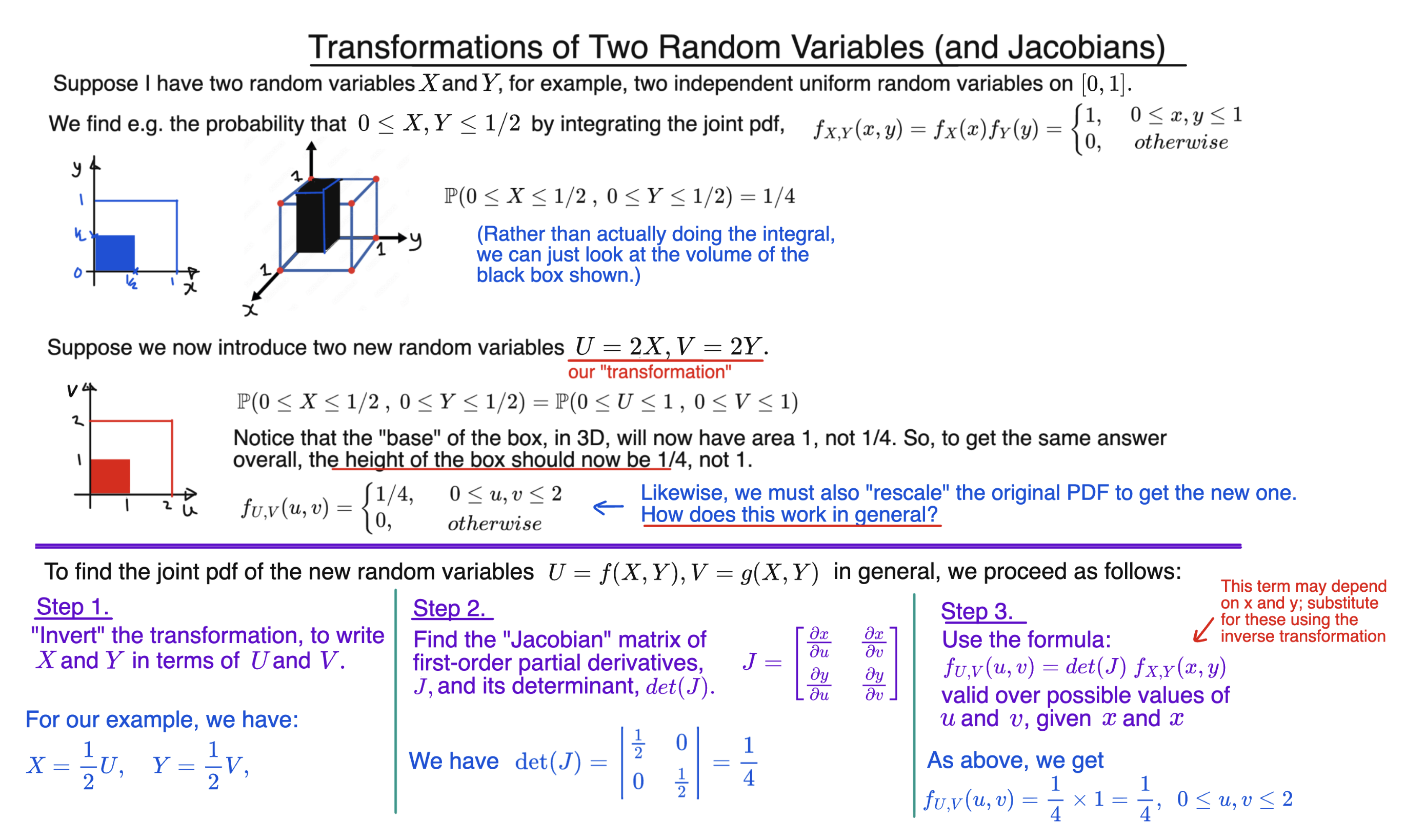
We explain the Jacobian method to find the joint PDF of two new random variables after a transformation.
Suppose we begin with two continuous random variables $X$ and $Y$.
We use these to define two new random variables:
$$U=f(X,Y), \ \ V=g(X,Y)$$
To find the joint PDF of $U$ and $V$, we can follow these three steps.
Firstly, find the inverse transformation.
This may require you to solve some simultaneous equations to find $X$ and $Y$ in terms of $U$ and $V$.
Secondly, differentiate $x$ and $y$ with respect to $u$ and $v$, and find the following matrix:
$$ J= \begin{bmatrix} \frac{ \partial x}{ \partial u} & \frac{ \partial x}{ \partial v} \\ \frac{ \partial y}{ \partial u} & \frac{ \partial y}{ \partial v} \end{bmatrix}$$
This matrix is called the Jacobian.
Thirdly, find the determinant of the Jacobian, $det(J)$, and compute:
$$ \ f_{U,V}(u,v) = \det(J) \ f_{X,Y}(x,y) $$
Be sure to write everything in terms of $u$ and $v$, and to identify the range of values of $u$ and $v$ for which this is valid. You can do this by considering what happens to $f(x,y)$ and $g(x,y)$ as $x$ and $y$ vary over their ranges.
For instance, suppose that $X$ and $Y$ have the following joint PDF:
$$f_{X,Y}(x,y) = 8xy, \ \ 0 \lt x \lt 1 \ \ \text{and} \ \ 0 \lt y \le x$$
We then define $U=X$ and $V=XY$. Let’s use the method to find the joint PDF of $U$ and $V$.
Step 1.
We find that $X=U$ and $Y=V/U$.
Step 2
The Jacobian is:
$$ J= \begin{bmatrix} 1 & 0 \\ \frac{-v}{u^2} & \frac{1}{u} \end{bmatrix}$$
Its determinant is:
$$ det(J)=\frac{1}{u} $$
Step 3
We compute:
$$ \ f_{U,V}(u,v) = \frac{1}{u} 8xy = \frac{1}{u} 8(u) \left( \frac{v}{u} \right) = \frac{8v}{u} $$
With a little care, we see that $U$ can vary between $0$ and $1$, since it is the same as $X$, and once $U$ is fixed, $V$ can be anywhere between $0$ and $U^2$. So, the above formula is valid for all $0 \lt u \lt 1, \ 0 \lt v \le u^2$.
This condition can be simplified to $0 \lt \sqrt{v} \le u \lt 1$.