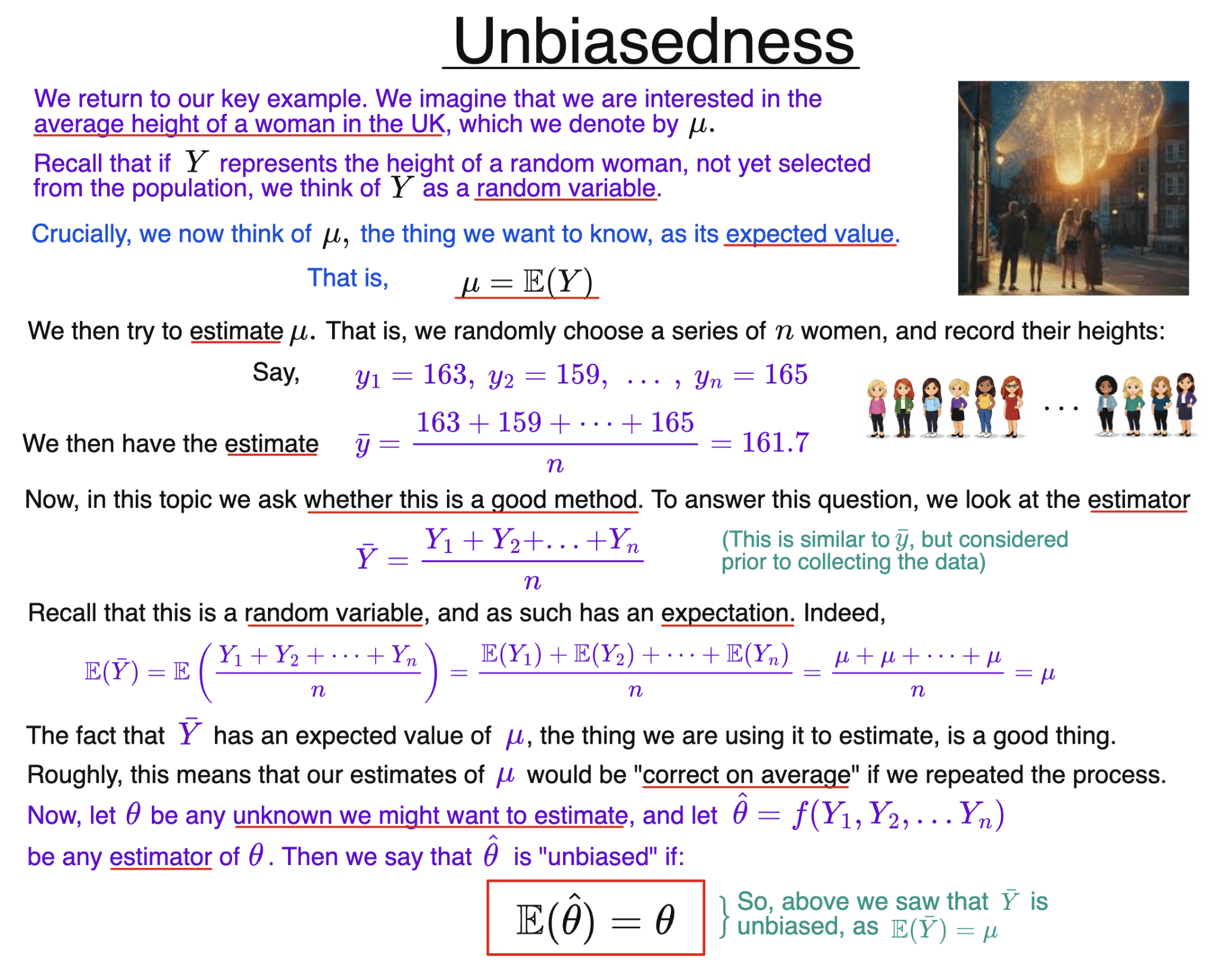
What is an Unbiased Estimator?
An estimator $\hat{\theta}$ of an unknown quantity $\theta$ is unbiased if its expectation is equal to $\theta$:
$$\mathbb{E}(\hat{\theta})=\theta$$
This is generally a good thing, since it says the estimator is “correct on average”.
For example, consider a random sample $Y_1,Y_2, \dots, Y_n$, independent with the same distribution, and each having the same mean $\mu = \mathbb{E}(Y_i)$. Then the sample mean is unbiased as an estimator of this shared mean $\mu$:
$$\mathbb{E}(\bar{Y})=\mathbb{E} \left( \frac{Y_1+Y_2+\dots+Y_n}{n} \right) =\mu$$
We can also define the bias of an estimator as the difference between its expected value and its target:
$$\operatorname{Bias}_{\theta}(\hat{\theta})=\mathbb{E}(\hat{\theta})-\theta$$
And unbiased estimator is then one for which the bias is $0$. Note that the bias depends on what target $\theta$ we are aiming for.