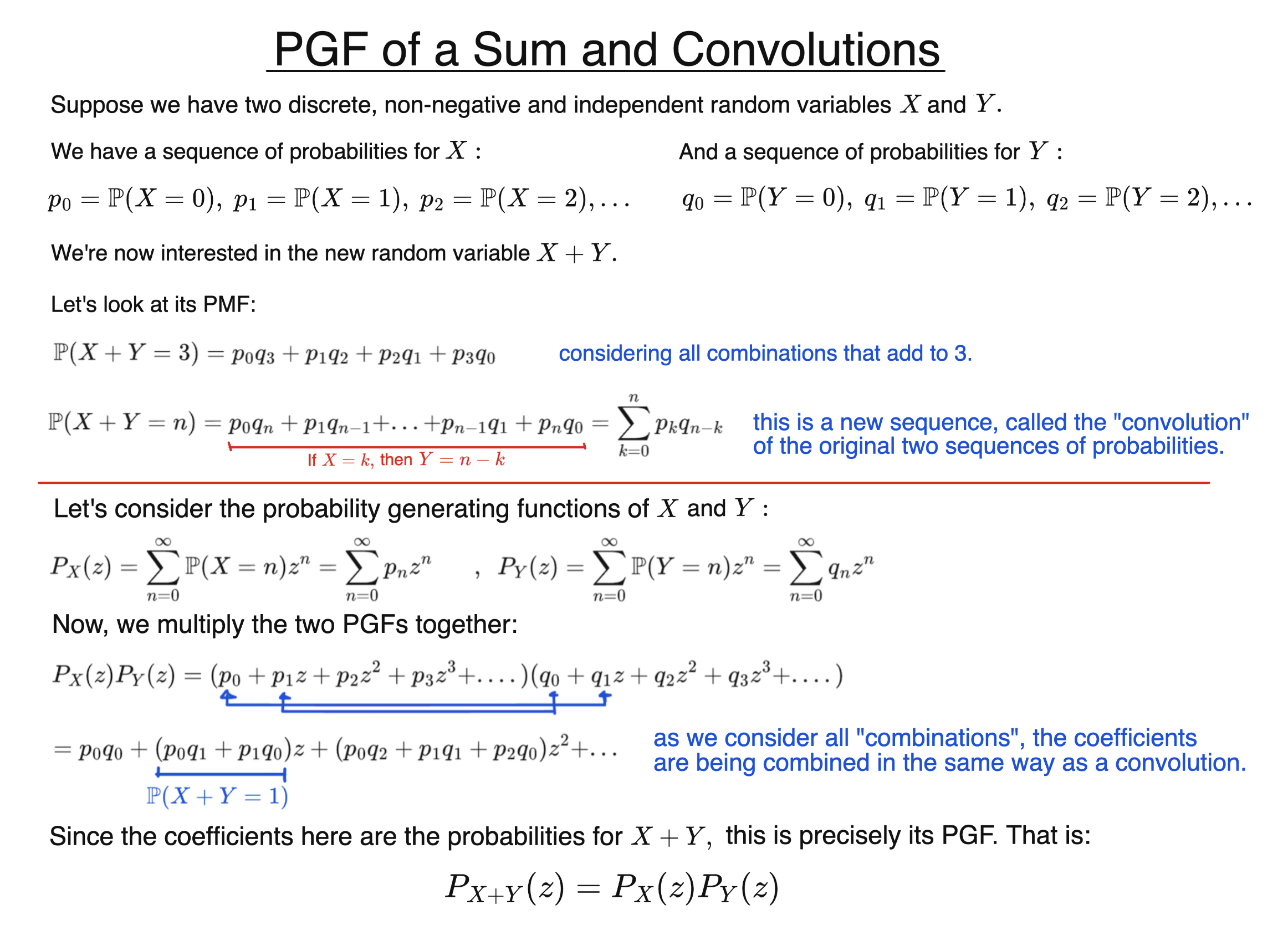
What is the PGF of $X+Y$ when $X$ and $Y$ are Independent?
To find the probability generating function of the sum of two independent random variables $X$ and $Y$, we can simply multiply together their individual PGFs.
That is, we have:
$$ P_{X+Y}(z) = P_X(z)P_Y(z) $$
So, the PGF of the sum is the product of the individual PGFs.
This is also the ordinary generating function of the convolution of the two sequences giving probabilities for $X$ and $Y$.
This happens because when we consider the events that $X+Y=n$, we consider all combinations of $X=x$ and $Y=y$ with $x+y=n$; whereas when we find the coefficient of $z^n$ in $P_X(z)P_Y(z)$, we take one term from each of $P_X(z)$ and $P_Y(z)$ whose powers also add up to $n$.
Explicitly, we define our first sequence as:
$$ p_0 = \mathbb{P}(X=0), \ p_1 = \mathbb{P}(X=1), \ p_2 = \mathbb{P}(X=2), \dots $$
and our second sequence as:
$$ q_0 = \mathbb{P}(Y=0), \ q_1 = \mathbb{P}(Y=1), \ q_2 = \mathbb{P}(Y=2), \dots $$
Then we have:
$$ P_X(z)P_Y(z) = (p_0 + p_1 z + p_2 z^2 + \dots)(q_0 + q_1 z + q_2 z^2 + \dots)$$
$$ = p_0q_0 + (p_0q_1+p_1q_0)z+(p_0q_2+p_1q_1+p_2q_0)z^2 \dots = P_{X+Y}(z)$$
An especially common situation in statistics is that we have $n$ random variables $X_1, X_2, \dots , X_n$, all independent and with the same distribution.
If these $X_i$ are discrete and non-negative, then since they each have the same PMF, they will all have the same PGF, $P_X$. Moreover, extending the above result, we can find the PGF of their sum:
$$ P_{X_1+…+X_n}(z) = \left(P_X(z) \right)^n$$