What is a Countable Set?
A random variable is discrete if the set of values it might take, $S$, is countable.
Roughly, a set being countable means that we can arrange its elements into a sequence,
$$a_1, a_2, a_3, \dots $$
This is what we mean by “listing” them. Each item in the set must occupy exactly one fixed position in the list, with no repetitions or elements of $S$ left out.
Examples of countable sets include $\mathbb{N}, \mathbb{Z}$ and $\mathbb{Q}$.
More formally, a set $S$ is countable if it is either finite or “countably infinite”.
The latter means that there is a bijective function between the set and the natural numbers, $\mathbb{N}$. That is, we map each “position number” in the list onto the unique element from $S$ that occupies that position within the list.
Some sets, like the interval $[0,1]$, are not countable, and cannot be listed out.
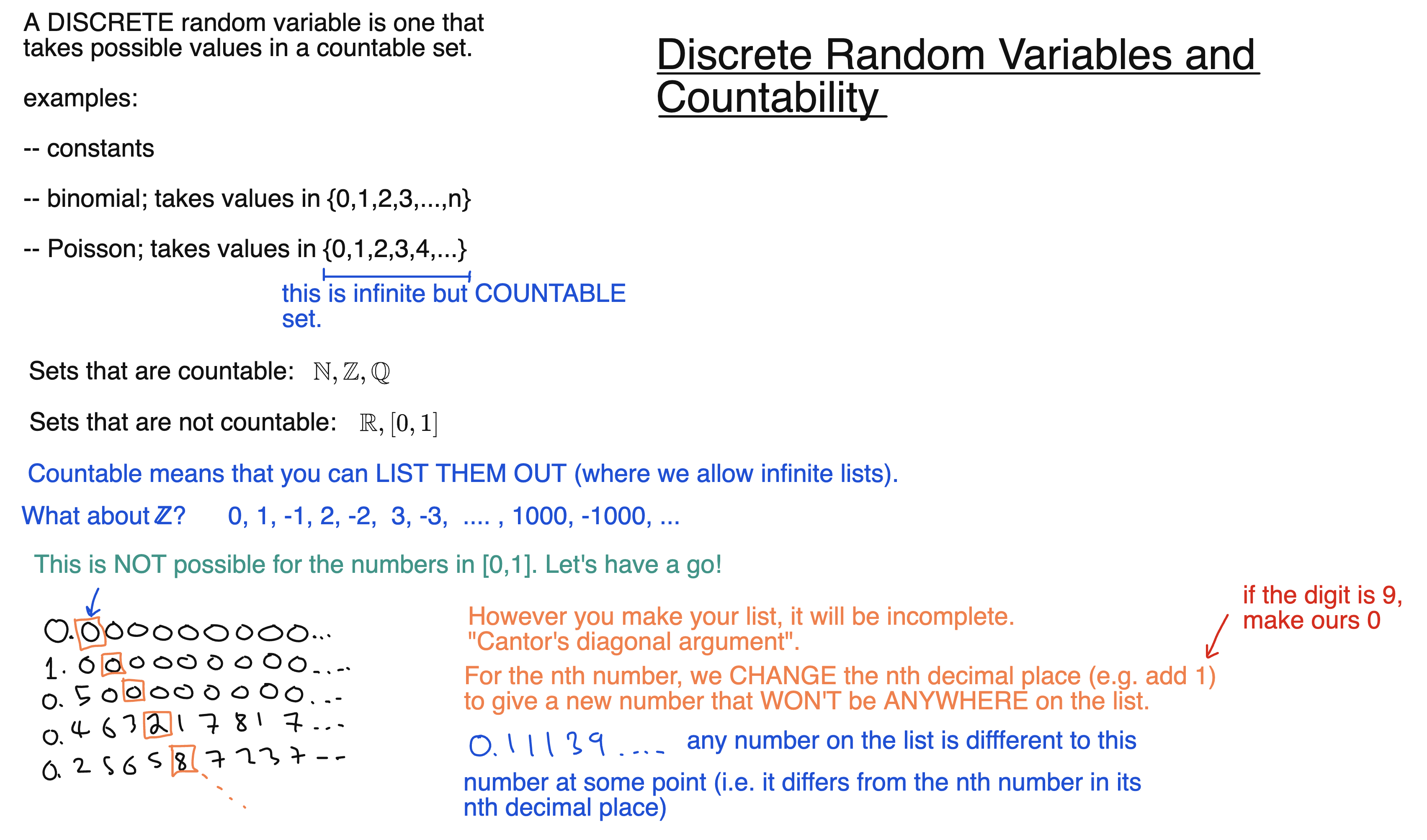
Georg Cantor was one of the first to distinguish between these different kinds of infinite sets, and the “diagonal” argument showing that $[0,1]$ is not countable bears his name.
Firstly, imagine that we can list all the real numbers in $[0,1]$ out. For instance, the start of our list might look like this:
$$0.14414331 \dots$$ $$0.12313452\dots$$ $$0.51543141\dots$$ $$0.66161244\dots$$ $$0.63141514\dots$$
Cantor’s argument works by concentrating on the $n^{th}$ digit of the $n^{th}$ number in the list; that is, those highlighted in red:
$$0. \textcolor{red}{1}4414331 \dots$$ $$0.1\textcolor{red}{2}313452\dots$$ $$0.51\textcolor{red}{5}43141\dots$$ $$0.661\textcolor{red}{6}1244\dots$$ $$0.6314\textcolor{red}{1}514\dots$$
He then argued that we could construct a new number that didn’t appear anywhere on the list, by ensuring that it was different to all of these numbers at the position marked in red.
For instance, let’s make a new number whose $n^{th}$ digit is always $5$, unless the $n^{th}$ number in the list itself has an $n^{th}$ digit of 5. In that case, we make it $6$. For the above list, we get:
$$ x = 0.55655 \dots $$
Since this number always differs from any number on the list, it will never appear on our list. Moreover, a similar number can be constructed for any given list. So, it is not possible to list out all the numbers in $[0,1]$. This means $[0,1]$ is not countable.
It follows that, e.g., if $X \sim \mathcal{U}[0,1]$ then $X$ is not discrete.
To be made completely precise, the argument requires us to note that some numbers like $0.043$ (decimals which stop after a certain point) can also be written as $0.042999 \dots $ These are the only cases of a number having more than one decimal expansion, and in our attempted listing we can agree to always write them in the former way.
To formalise the idea of “values $X$ might take”, we need measure theory.